




Two and Four Stroke Engine and Lubrication Needs
Two-stroke and 4-stroke engines are designed differently and operate under different conditions, requiring different lubrication methods.
Internal combustion engines are used to produce mechanical power from the chemical energy contained in hydrocarbon fuels. The power producing part of the engine's operating cycle starts inside the engine's cylinders with a compression process. Following compression, the burning of the fuel-air mixture releases the fuel's chemical energy and produces high-temperature, high-pressure combustion products. These gases expand within each cylinder and transfer work to the piston, producing mechanical power to operate the engine.
Each upward or downward movement of the piston is called a stroke, and the two commonly used internal combustion engine cycles are the two-stroke cycle and the four-stroke cycle. The terms "two cycle" and "two stroke", as well as "four-cycle" and "four-stroke" are often interchanged.
Two-Stroke and Four-Stroke Differences

The fundamental difference between two-cycle and four-cycle engines is in their gas exchange process, or more simply, the removal of the burned gases at the end of each expansion process and the introduction of a fresh mixture for the next cycle. A two-stroke engine has an expansion, or power-stroke, in each cylinder during each revolution of the crankshaft. The exhaust and the charging processes occur simultaneously as the piston moves through the lowest of bottom center position.

In a four-stroke engine, the burned gases are first displaced by the piston during an upward (exhaust) stroke, and a fresh charge enters the cylinder during the following downward (intake) stroke.
Four-stroke engines require two complete turns of the crankshaft to make a power stroke, compared to the single turn necessary in a two-stroke engine. Two- stroke engines operate on 360 degrees of crankshaft rotation, whereas four-stroke engines operate on 720 degrees of crankshaft rotation.
Two-stroke engines are generally less expensive to build compared to four-stroke engines, and they are lighter and can produce a higher power-to-weight ratio. For these reasons, two-stroke engines are ideal in applications such as chainsaws, weed eaters / trimmers, blowers, outboard motors, off-road motorcycles and racing applications. Due in part to their design and lack of an oil sump, two-stroke engines are also easier to start in cold temperatures, making them ideal for use in snowmobiles.
How Does Four-Stroke Lubrication Work?
Four-stroke engines are lubricated by oil held in an oil sump. The oil is distributed through the engine by splash lubrication or a pressurized lubrication pump system; these systems may be used alone or together.
Splash lubrication is achieved by partly submerging the crankshaft in the oil of the oil sump. The momentum of the rotating crankshaft splashes oil onto other engine components such as the camshaft lobes, piston wrist pins and cylinder walls.
Pressurized lubrication uses an oil pump to deliver a steady supply of filtered oil that provides a pressurized film of lubricant between moving parts such as main bearings, connecting rod bearings, and camshaft bearings. It also pumps oil to the engines's valve guides, rocker arms and hydraulic lifters. Eventually, the oil drains back into the oil sump, where the oil pump again sends it on its way in a continuous cycle.
How Does Two-Stroke Lubrication Work?
Two-stroke engines collect some oil beneath the crankshaft; however, two-stroke engines employ a total-loss lubrication system that combines oil and fuel to provide both energy and engine lubrication. The oil and fuel are combined in the cylinder's intake tract as a mist and lubricate critical components such as the crankshaft, bearings, connecting rods and cylinder walls.
Oil-injected two-stroke engines use an oil pump to inject oil from an external oil reservoir directly into the engine, where it mixes with the fuel. This pump system can deliver oil directly to main bearings, crankpin bearings, and cylinder walls. Pre-mix two-stroke engines require a fuel oil mixture that is combined manually before installed in the fuel tank.
Detergency and lubricity are a two-stroke oil’s two most important characteristics.
To protect the engine and deliver long life, two-stroke oil must deliver two primary features: detergency and lubricity.
Fewer Deposits Maintains Engine Power
Because two-stroke engines are designed to burn oil, deposits can form on the piston crown, in the ring grooves and in the exhaust port or on the spark-arrestor screen (if equipped). Crown deposits can absorb heat from the burning fuel and oil, creating hot spots that can ignite the fuel/oil mixture before the spark plug fires, which is known as pre-ignition. Pre-ignition can spike combustion-chamber temperature and pressure, resulting in catastrophic engine damage.
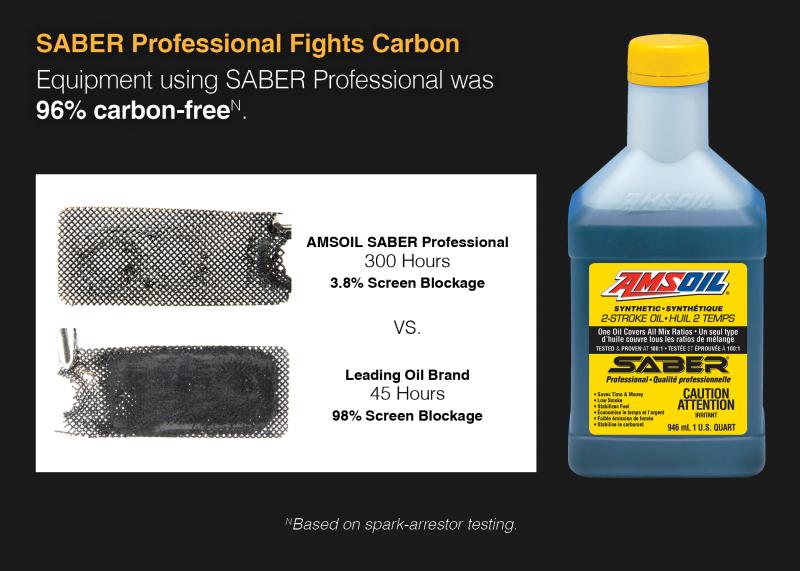 Deposits can also cause the rings to stick in their grooves rather than press tightly against the cylinder wall and seal the combustion chamber. If a proper seal is not formed, gases and heat from combustion can escape past the piston and burn the lubricant off the cylinder wall. This is known as blow-by, which results in piston scuffing, lost performance and even engine failure. Heavy exhaust-port or sparkarrestor- screen deposits, meanwhile, can restrict air enough to reduce engine power and even kill the engine. This is especially frustrating for professional landscapers using string trimmers or backpack blowers that start hard and lack power to get the job done. To avoid these problems and maximize engine operability and life, two-stroke oil must contain potent detergents that fight deposits and keep components clean. This translates into equipment that starts easily, delivers optimum power and lasts for years. As the spark-arrestor-screen images show, AMSOIL SABER Professional Synthetic Two-Stroke Oil (ATP) delivers clean, protected power so equipment provides maximum power and lasts for years.
A Lubricant's lubricity Is Key
Lubricity describes an oil’s friction reduction properties. It’s critical for managing the excess heat and high rpm common to two-stroke engines. High heat is generated not only from combustion, but from piston-to-cylinder friction. If the oil burns too easily from combustion or does not provide the needed lubricity for piston lubrication, piston scuffing will occur, causing reduced performance and even engine failure.
The base oils provide the lubricant’s lubricity, and synthetics deliver the level of friction-reduction hot-running two-stroke engines need. In fact, AMSOIL SABER Professional provides such good lubricity, it’s guaranteed for any mix ratio up to 100:1. Even when using half the oil compared to traditional 50:1 mix ratios, it provides exceptional protection. What’s more, using half the oil saves operators up to 50 percent on oil costs. SABER Professional not only delivers the detergency and lubricity two-stroke engines need, it does so at half the cost.




 Canada
 United States